
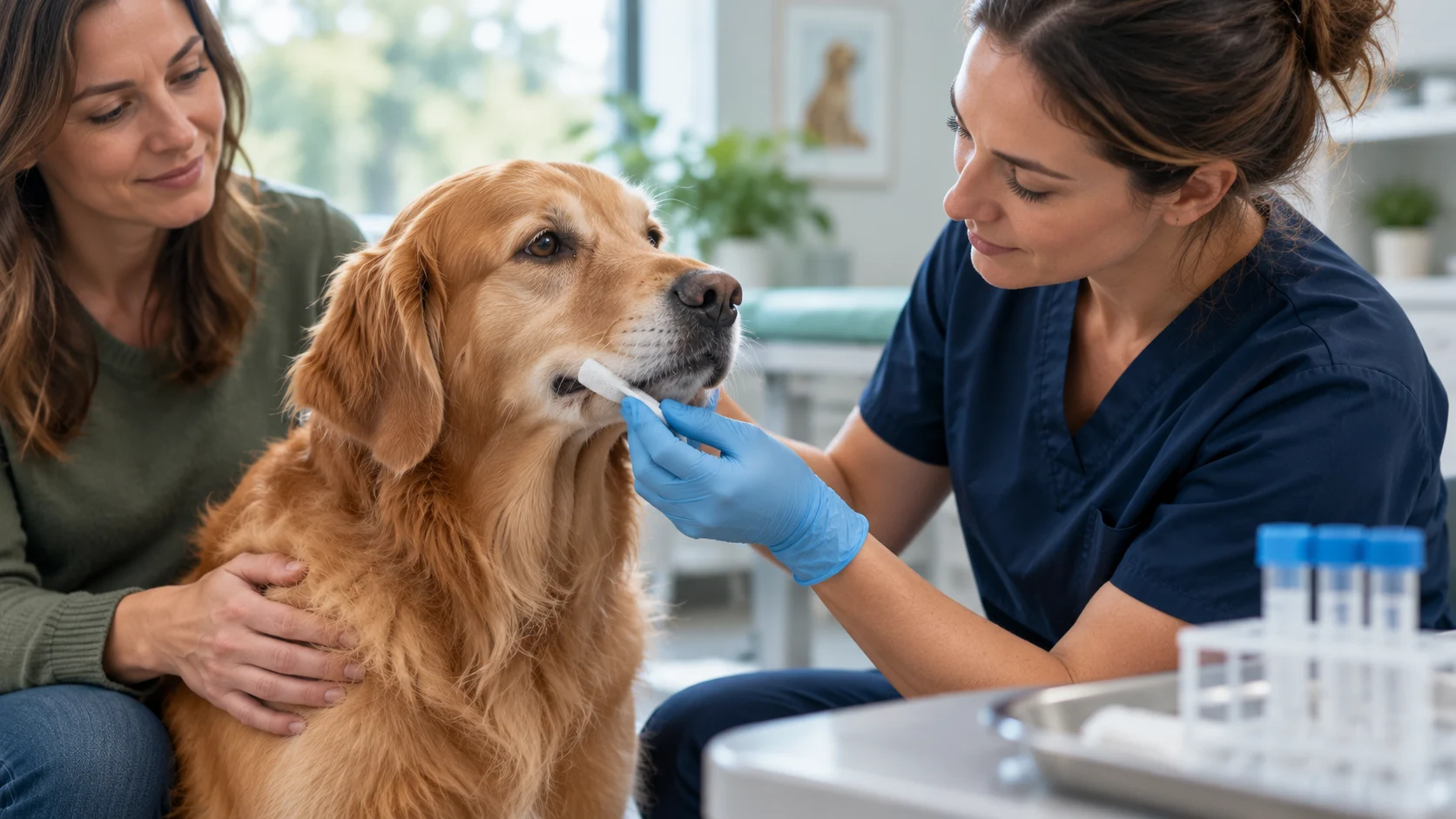
In short: Saliva lets researchers measure stress and bonding hormones in dogs without a needle. A 2025 study of 14 therapy dogs working in a stroke rehabilitation unit found their salivary cortisol and oxytocin stayed stable across a session, suggesting the work did not stress them. A 2025 review of 16 studies on salivary oxytocin and vasopressin in dogs adds an important caution: results vary a lot with how saliva is collected.
This article describes published research. Oasis Diagnostics devices are for research use.
Key takeaways
- Saliva has been called a potential solution for measuring animal welfare non-invasively.
- In a therapy-dog study (14 dog–handler pairs), cortisol and oxytocin levels did not change significantly after a 30-minute rehabilitation session, while right ear temperature rose significantly.
- A scoping review of 16 studies from 2017 to 2024 found large variability in salivary oxytocin and vasopressin concentrations, which depended partly on the collection method.
- Dogs need to be acclimatised to the swab, and collection method choice should be reported.
Why saliva for dogs?
The scoping review’s authors say identifying reliable indicators of animals’ emotional states is a major challenge in animal welfare science, and that salivary hormones are a potential non-invasive solution. Oxytocin has been suggested as an indicator of a positive welfare state in several species including the domestic dog, and the therapy-dog study describes higher salivary cortisol as associated with higher stress and higher oxytocin with reduced stress. Collecting saliva avoids the handling that a blood draw needs.
Example: therapy dogs in stroke rehabilitation
Therapy dogs are increasingly used in medical treatment programs, but the authors note that research on their own stress is limited. The study placed 14 therapy dog–handler pairs in an inpatient stroke rehabilitation program, where they walked with patients, played fetch and were petted or brushed during 30-minute sessions.
To measure stress, the team collected saliva, ear temperature, heart rate and heart rate variability, and behaviour before and after each session.
How the saliva was collected. The researcher collected saliva before the session in a room separate from the patient and away from distractions, and again afterwards. Saliva was collected with a Super•SAL 2 swab, held in the dog’s mouth until saturated over two minutes, and the dog was allowed to chew the swab. The sponge was then cut into a syringe, the saliva extracted into a tube, centrifuged, and the supernatant stored at −80 °C and shipped on dry ice for analysis. Cortisol was measured by an enzyme immunoassay, and oxytocin by liquid chromatography–mass spectrometry.
What they found. Right tympanic temperature increased significantly after the session, but there was no significant difference in salivary cortisol or oxytocin, or in stress-related behaviour. Both hormones were numerically lower after the session. The authors conclude that the program did not induce stress in the dogs and that they may have been more relaxed afterwards. They also point out that other studies have found different results, and that differences in sample type and research design may explain these discrepancies better than real biological differences.
What the wider literature says
The scoping review covered 16 peer-reviewed studies of salivary oxytocin and vasopressin in dogs published from 2017 to 2024, mostly about social and maternal behaviour. It found:
- Wide variation. Average salivary oxytocin concentrations across the included studies ranged from about 100 to over 3,000 pg/mL, and average vasopressin from about 50 to 700 pg/mL.
- The collection medium matters. Different swabs have different physical properties that can affect which components of saliva are absorbed. One validation study that compared synthetic swabs and stimulation techniques found variability in results depending on the method.
- Common practice. In most studies a sponge was placed in the dog’s mouth, typically in the cheek, for about one minute without stimulants. Food odour was used to stimulate salivation in two studies.
- Devices. The tables list the Salimetrics Children’s swab in six studies and the Sarstedt Salivette in five (plus two that used a sponge in a Salivette tube), with Versi•SAL from Oasis named in two studies (one method validation and one application study).
- Acclimatisation. The authors caution that not all animals are used to chewing on a swab, which should be considered in study design.
What this means for canine saliva studies
- Decide and report the method. Device, collection time and any stimulation can all change results.
- Acclimatise the dog. A dog unwilling to accept the sponge may not give a comparable sample. In one included study, salivary oxytocin was significantly lower in dogs that were reluctant to accept the sponge or did not relax during stroking.
- Control timing. The studies collected samples at different intervals after the stimulus, so record it.
- Avoid comparing across methods. The review says variability depended on the methods used, so compare like with like.
Related Oasis products
- Super•SAL 2: the swab used in the therapy-dog study.
- Micro•SAL: a small animal collection device for cats, small dogs, piglets and more.
- Versi•SAL: the kit named in two of the review’s included studies.
- Research that used Oasis devices
Sources
- Behavioral and physiological responses of therapy dogs to animal-assisted treatment in an inpatient stroke rehabilitation program. Animals. 2025. https://doi.org/10.3390/ani15020121
- De Santis M, et al. A scoping review on salivary oxytocin and vasopressin measurement in the dog. Animals. 2025. https://doi.org/10.3390/ani15162421