Super•SAL™
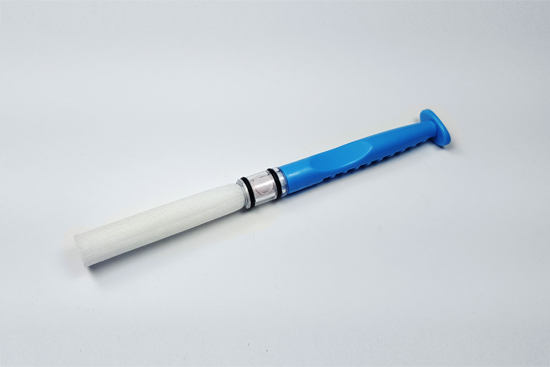
The Super•SAL™ Saliva Collection Kit collects saliva via a highly absorbent cylindrical-shaped pad from the pool of saliva that collects in the mouth. Intended as a high volume saliva collector (>1.0 mL), it provides a clean specimen in approximately 1–3 minutes and includes a sample volume adequacy indicator that changes from yellow to blue when sufficient sample has been collected.
Key Features
High Volume Collection
Collects >1.0 mL of clean saliva from the oral pool in approximately 1–3 minutes via a cylindrical absorbent pad.
Sample Volume Adequacy Indicator
Indicator changes from yellow to blue when sufficient sample has been collected, removing guesswork.
Universal Sample Kit
Validated for saliva, vaginal specimens, urine, amniotic fluid, and samples from multiple animal species.
Versatile Analyte Detection
Used to collect hormones, bacteria, viruses, drug molecules, and proteins across a wide range of applications.
For Research Use Only (RUO)
Super•SAL™ is intended for research use only in the United States and is not FDA-cleared for diagnostic use.
About Super•SAL™
How Super•SAL works
The Super•SAL™ Saliva Collection Kit collects saliva with a highly absorbent, cylindrical-shaped pad placed in the pool of saliva that gathers in the mouth. It is intended as a high-volume saliva collector, taking more than 1.0 mL and giving a clean specimen in approximately 1–3 minutes.
A built-in sample volume adequacy indicator changes from yellow to blue when enough sample has been collected, so the person collecting does not have to guess whether the sample is sufficient.
One kit for many sample types
Super•SAL is a universal sample kit. It has been validated for saliva, vaginal specimens, urine, amniotic fluid and samples from multiple animal species. Researchers use it to collect hormones, bacteria, viruses, drug molecules and proteins.
Used in published research
Published studies that used Super•SAL include a paper-based colorimetric molecular test for SARS-CoV-2 in saliva, work on the salivary microbiome and cytokines in oral lichen planus, a comparison of saliva collection methods for cortisol in rhesus macaques, a rapid syphilis test using oral fluid, and a salivary biomarker panel for Parkinson's disease. The full list is in the Resources section below.
Frequently Asked Questions
How much saliva does Super•SAL collect?
It is intended as a high-volume collector, taking more than 1.0 mL of saliva, typically in about 1–3 minutes.
How do I know enough sample has been collected?
The built-in sample volume adequacy indicator changes from yellow to blue when sufficient sample has been collected.
What can be measured in saliva collected with Super•SAL?
The kit has been used to collect hormones, bacteria, viruses, drug molecules and proteins. The publications listed on this page show examples.
Can Super•SAL be used with animals or other fluids?
Yes. It is described as validated for saliva, vaginal specimens, urine, amniotic fluid and samples from multiple animal species.
Where can I find instructions?
The product insert and step-by-step instructions, in English and Spanish, are in the Resources section of this page.
Resources
Documentation
Publications
- 01 A Paper-Based Colorimetric Molecular Test for SARS-CoV-2 in Saliva (J. Wang 2021)
- 02 Cytokines Levels and Salivary Microbiome Play A Potential Role in Oral Lichen Planus Diagnosis (M. Carvalho 2019)
- 03 Saliva Sampling: Methods and Devices. An Overview (Fuoco R. 2019)
- 04 Use of Oral Fluid in a Rapid Syphilis Test Assay (Shannon C. 2017)
- 05 Comparison of Saliva Collection Methods for Salivary Cortisol in Rhesus Macaques (Rapp-Santos 2017)
- 06 Human Saliva Collection Devices for Proteomics: An Update (Khurshid Z. 2016)
- 07 Human Saliva — A Future Diagnostic Tool (Khurshid Z. 2016)
- 08 Salivary Biomarkers for Parkinson's Disease: Statistical Analysis for Panel Selection (Shirtcliff E. 2015)
- 09 Susceptibility of calves fed unpasteurized milk from cows infected with highly pathogenic avian influenza H5N1 (Sarlo Davila KM. 2026)
- 10 Dairy cows inoculated with highly pathogenic avian influenza virus H5N1 (Baker AL. 2025)
- 11 A Wearable Electrochemical Biosensor for Salivary Detection of Periodontal Inflammation Biomarkers: Molecularly Imprinted Polymer Sensor with Deep Learning Integration (Jeon S. 2025)
- 12 Cohort profile: the Genetics of Glucose regulation in Gestation and Growth (Gen3G) - a prospective prebirth cohort of mother-child pairs in Sherbrooke, Canada, 3-year and 5-year follow-up visits (Taschereau A. 2025)
- 13 Salivary Titanium Level as a Non-invasive Biomarker for Peri-Implantitis: A Prospective Study (Sharma K. 2025)
- 14 Comparisons of Methods for Mucus Sampling and Mucin Semi-Quantification on Barramundi (Lates calcarifer) and Atlantic Salmon (Salmo salar) Epithelial Sites (Lee KM. 2025)
- 15 Pathogen Detection in Early Phases of Experimental Bovine Tuberculosis (Palmer MV. 2024)