In short: Secretory immunoglobulin A (SIgA) is the most abundant antimicrobial protein in saliva, and sport scientists measure it to study how exercise affects mucosal immunity. A 2025 study in the European Journal of Sport Science combined a marathon field study with a controlled lab study and found that anxiety and mood disturbance were linked both to infection risk after the race and to the saliva SIgA response to exercise. It is also a clear example of choosing a saliva collection method for practical reasons in the field, and checking it against passive drool.
This article describes published research. Oasis Diagnostics devices are for research use.
Key takeaways
- In the marathon study, 406 adults recorded respiratory tract infection (RTI) symptoms for two weeks before and after the race; 50 runners had an RTI afterwards.
- Runners who reported higher trait anxiety or total mood disturbance beforehand were more likely to have an RTI after the race (odds ratios 1.06 and 1.04).
- Higher trait anxiety and mood disturbance were also associated with a greater drop in saliva SIgA after the marathon.
- There was no association between the change in mucosal immunity and RTI risk in this study.
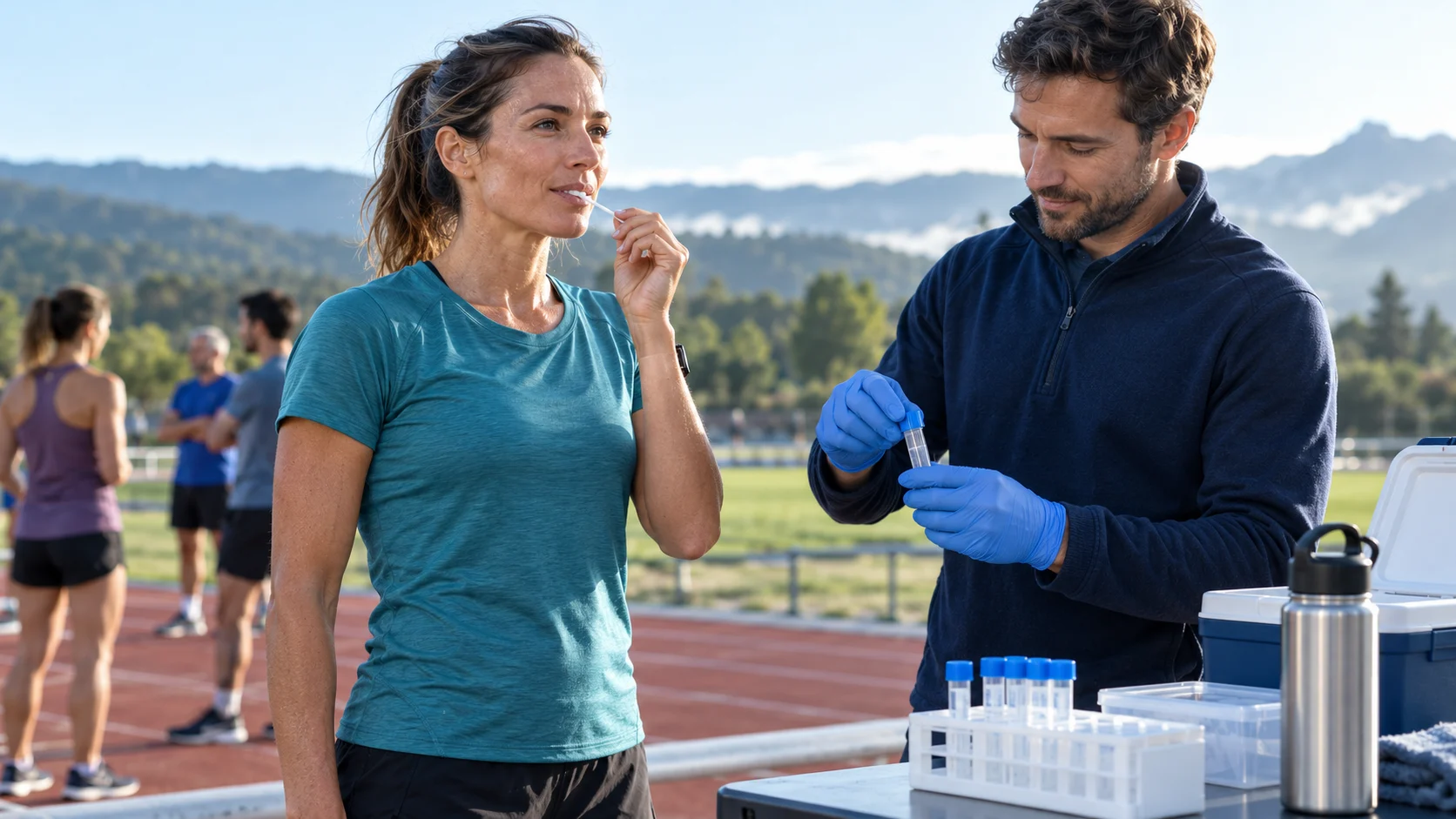
- Saliva at the marathon was collected with a pre-weighed Versi•SAL swab placed under the tongue for 2 minutes, chosen because it let many samples be taken quickly where there were no chairs for passive drool.
Why measure SIgA in saliva?
The authors explain that SIgA is the most common measure of mucosal immunity because it is the most abundant antimicrobial protein in saliva, with lower levels in saliva and tears linked to a higher risk of respiratory tract infection. They also note that results for SIgA after endurance exercise have often been inconsistent, which they attribute to differences in exercise type, intensity and duration, and to inconsistencies in how saliva is collected, handled, stored, analysed and reported. That last point is where collection method matters.
The two studies
Study 1: a marathon. Runners in the Snowdonia Marathon, a mountainous race with 939 m of total ascent, completed questionnaires on anxiety and mood before the race and reported symptoms twice a week for two weeks before and after. Saliva was collected before and immediately after the race.
Study 2: a lab experiment. 45 adults completed 60 minutes of running at 65% of peak oxygen uptake and a seated-rest control, in random order, with saliva collected before, immediately after and 30 minutes after.
How saliva was collected, and why
| Study 1 (marathon) | Study 2 (laboratory) | |
|---|---|---|
| Method | Pre-weighed Versi•SAL swab under the tongue, mouth closed | Passive drool into a pre-weighed tube, leaning forward |
| Time | 2 minutes | 5 minutes, extended up to a maximum of 9 minutes if under 200 µL |
| Why | Practical: many samples in a short window where chairs were not available for passive drool | Controlled setting suited to drool |
| Handling | Stored at 4 °C for transport, then weighed | Weighed after collection |
The authors say pilot data from their own laboratory showed similar SIgA concentrations and secretion rates with passive drool and the Versi•SAL swab. In both studies they weighed the sample to work out saliva flow rate, then calculated the SIgA secretion rate from flow rate and concentration.
What they found
- Infection risk. High trait anxiety or mood disturbance before the marathon was associated with a higher chance of an RTI afterwards (odds ratio 1.06, 95% CI 1.02–1.11, and 1.04, 95% CI 1.01–1.07).
- Saliva SIgA. Higher trait anxiety and mood disturbance were associated with a greater reduction in saliva SIgA after the race.
- Link between SIgA and infection. No association between mucosal immunity and RTI risk (odds ratio 1.00, 95% CI 0.97–1.01).
- Laboratory study. There was no significant difference between exercise and rest overall, but in men, psychological measures were associated with the SIgA secretion rate response to exercise (correlations from −0.55 to −0.66).
The authors conclude athletes should look after psychological wellbeing to support immune health, and researchers should account for psychological factors when studying the mucosal immune response to exercise.
What this means for field saliva collection
- Choose for the setting. A swab held under the tongue worked where drooling was impractical.
- Check against a reference method. The team compared swab and drool in pilot work before relying on the swab.
- Standardize time and weight. Both studies recorded collection time and weighed samples so flow rate and secretion rate could be calculated.
- Control handling. Samples were kept cold for transport and processed consistently.
Related Oasis products
- Versi•SAL: kits with an interchangeable absorbent pad and a sample sufficiency indicator that triggers at adequate volume in about 2–3 minutes, in standard and split-sample configurations.
- Super•SAL: a high-volume collector for more than 1.0 mL in about 1–3 minutes.
- Research that used Oasis devices
Sources
- Anxiety and mood disturbance are prospectively associated with respiratory infection risk and the mucosal immune response to exercise. Eur J Sport Sci. 2025. https://doi.org/10.1002/ejsc.70058